When I started my fire service career, I began a collection. Lots of firefighters have collections. Some collect fire figurines, for others its patches, I even know a few guys that collect full-sized retired engines and trucks. Some of the things I collect came easy; others I had to dig for. By now you’re getting ready to log off, so I’ll spill what it is that I collect. I collect memories.
If you’re a fan of Harry Potter, you’ll probably remember the Pensieve in Dumbledore’s office. If you’re not a fan, it was a bird-bath type of contraption that the most wise and powerful wizard used to store memories. He could look into his memories and bring them back in full detail. If someone else looked into his memories, they could observe Dumbledore’s memories as if they had been there too. Dumbledore used this bit of wizardry to carefully review long-past memories seeking out minute details, while trying to solve mysteries. Even the most wise and powerful wizard admitted that he couldn’t recall every detail regarding all his memories. Dumbledore shared some of his memories with Harry in order to “teach” him things about his enemy, Voldemort.
How unfortunate it is that we don’t have Pensieve’s in the fire service. Imagine being able to see, through the eyes of each the officers you’ve been assigned to; all the fires they have fought and learn the lessons they have learned. (I’m sure Vincent Dunn would have a mess of memories available on DVD’s).
In the 1980’s, the military wanted to learn the decision making process of highly effective combat officers. What they found was a process called Recognition Primed Decision Making (RPDM). They found that effective fire officers too used RPDM when confronted with on-scene situations. To view a very informative report on this process go to:
http://www.standto.com/rpdm.html
In short, both military combat officers and effective fire officers have a “slide-show” in their brain. When confronted with a situation, in a nano-second, the officer views their slide-show to try to best match the current situation with one that they have seen in the past. Sometimes there isn’t an exact match, but usually if you’re an experienced officer you’ve seen something similar…enough.
So now that you have a better idea about what RPDM is, what can you do with this information? As I said earlier in this posting, some of my collection came easy like learning not to touch the steel doors of the burn building without your gloves on no matter how long the fire has been out (wow, that hurt!). Other memories I had to dig for. Back when I was riding the ambulance (yes, I did!), if we had a call where the paramedic did some critical interventions, I would bug them on the way home to explain to me, what was physically happening with the patient, what intervention they did, and it changed the physiological status (or was supposed to) of the patient. I was lucky I worked with a lot of good paramedics back-in-the-day. To this day, current paramedics sometimes call me a “closet-medic”. I usually have a pretty good idea what is going on with the patient and how to alter the course though interventions.
Here is where you come in. If you’re a seasoned officer, you must share your on-scene observations and how it affected your decision making process with those with whom you work. If you’re a young-buck, ask questions without out being a pest. If an officer knows you are seeking guidance to fill your “slide-show”, they will most likely share their experiences (often in the form of war-stories) with you. There is a lot to learn.
In closing, I would like to acknowledge one of those great fire officers, and who turned my on to the concept of RPDM many, many years ago. Chief George Morgan (there is a Pensieve I’d like to glare into…or maybe not! ;-)) was always a wealth of knowledge. It was years later that I further explored the concept that I formally knew what he was talking about.
Monday, November 21, 2011

Thursday, November 17, 2011
Communications 101
Question: Do you know what the term Collyer’s Mansion means? Three…Two…One: Time
I have heard a number of very knowledgeable officers use this term, and had to do a little time with Uncle Google to find out what Collyer’s Mansion means. Collyer’s Manson syndrome is another term for the disorder commonly called being a hoarder. Most of us have been exposed to a hoarder sometime in our fire service career; if not it’s only a matter of time.
The point of this posting is to reinforce the use of common language to identify common problems. On the radio this morning I heard an unit officer ask our dispatch center to make a note in our dispatch notes for this address that indicated that the house was a Collyers Mansion situation. That would be acceptable if that officer is the only person that responds, but what about the newly promoted officer, or the firefighter acting above class? Will they know what that means?
We all pretty much know what a hoarder is, if not watch the high-numbered channels on basic cable.
I have heard a number of very knowledgeable officers use this term, and had to do a little time with Uncle Google to find out what Collyer’s Mansion means. Collyer’s Manson syndrome is another term for the disorder commonly called being a hoarder. Most of us have been exposed to a hoarder sometime in our fire service career; if not it’s only a matter of time.
The point of this posting is to reinforce the use of common language to identify common problems. On the radio this morning I heard an unit officer ask our dispatch center to make a note in our dispatch notes for this address that indicated that the house was a Collyers Mansion situation. That would be acceptable if that officer is the only person that responds, but what about the newly promoted officer, or the firefighter acting above class? Will they know what that means?
We all pretty much know what a hoarder is, if not watch the high-numbered channels on basic cable.
Friday, April 1, 2011
Pyramid
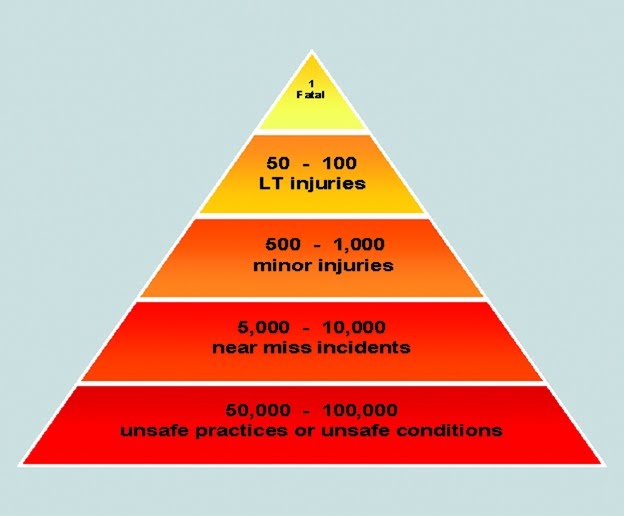
I have to apologize for my lack of contributions lately; I was pretty busy with college and preparing for the promotional process.
Recently, a good friend and I were talking about worker safety. He attended a seminar in which the presentation included a section that discussed a “Risk Triangle” shown below. If you start at the bottom of the triangle it lists unsafe practices and associates a number of those unsafe practices. The next step up the triangle shows us near misses. Up one more is minor injuries. Then it shows life threatening injuries and finally a single fatality. You may be asking what this has to do with the fire service. What the triangle shows is the progression and escalation of dangerous actions.
Look we’ve all done things on the fireground that are unsafe practices, more than a few of us have had near misses; a few have received minor injuries. Thankfully life threatening injuries are few and in the modern era, our department has never had a on the job death. I pray it stays this way.
What is often forgotten is the other basic building block listed unsafe conditions. These can be operational based unsafe conditions, but it can also be unsafe conditions in the stations, during training, or just driving to and from miscellaneous details. This could provide a significant number of “events” that contribute to our overall exposure to injury liability.
So what do you do? The pyramid is built on a wide base and each of the other levels is derived from the corresponding number below (e.g. 5,000-10,000 near misses are 10% of the 50,000-100,000 unsafe conditions/practices). What you can do is reduce the number at the base, and thereby reduce the probability of the climbing to the next level. If it takes a single employee 50 years to accumulate 50,000 unsafe practices/conditions, the employee will most likely retire before he encounters a fatal event. A different employee may reach the 50,000 unsafe practices/conditions in 5 years. If so, the second employee will most likely enjoy any retirement. The way to reduce your pyramid is to whittle away at the base. As you decrease your number of unsafe practices/conditions, your career survivability skyrockets.
Each year hundreds of thousands of tourists visit Egypt and Latin America to climb to the top of the pyramids. Let’s hope that we never see the top of ours.
Authors Note #1: The graphic represents a different industry. I believe the fire service numbers to be much lower
Authors Note #2: This logic is not an exact science, as employees could have fatal accidents long before accumulating 50,000 unsafe practices. The numeric representation is a representation meant for job/industry wide occurrence..
Friday, November 5, 2010
Legal Issues: Locker Searches
I need to say that this posting should not be used as legal advice. This question was posed to my class as part of a college course. The response is my fault.
In Chicago Fire Fighters IAFF Local 2 v. City of Chicago, 717 F Supp. 1314 (N.D. Ill, 1989), fire station locker searches were upheld as constitutional because the firefighters did not have a reasonable expectation of privacy in the contents of their lockers. What if the fire department did not inform the firefighters - through discussion with the union and issuance of general orders - that the locker searches would be conducted? Would the case come out the same way?
When considering the admissibility of the cooler of beer found during a search of the fire fighters in-station locker, the question arises whether the fire officials from the City of Chicago Fire Department were required to obtain a search warrant before the search of the locker was conducted. This action raises several issues that must be considered. 1) seach and seizure law regarding warrant requirements and reasonable expectional of privacy of public employees in their place of work.
Existing Laws
The Fourth Amendment of the United States Constitution provides:
The right of the people to be secure in their persons, houses, papers, and effects, against unreasonable searches and seizures, shall not be violated, and no Warrants shall issue, but upon probable cause, supported by Oath or affirmation, and particularly describing the place to be searched, and the persons or things to be seized. (U.S. Constitution)
The Fourth Amendment applies to the actions of the federal government and federal employees. The states, counties, and municipalities were included in the protections offered by the Fourth Amendment by virture of the Fourteenth Amendment to the Constitution which reads in pertinent part:
No State shall make or enforce any law which shall abridge the privileges or immunities of citizens of the United States; nor shall any State deprive any person of life, liberty, or property, without due process of law. (U.S. Constitution)
In O’Connor v. Ortega (1987), the U.S. Supreme Court found that public employees do have a reasonable expectation of privacy in their work are noting “Regardless of any expectation of privacy in the office itself, the undisputed evidence supports the conclusion that respondent had a reasonable expectation of privacy at least in his desk and file cabinets” (para.1). Yet the Court differetiates as to who condcts the search in stating “However, the operational realities of the workplace may make some public employees' expectations of privacy unreasonable when an intrusion is by a supervisor, rather than a law enforcement official” (para 1).
The U.S. Supreme Court upholds workplace searches that in Shields v Burge (1984), stating that “A workplace search to investigate work-related misconduct ordinarily is ‘justified at its inception’ if reasonable grounds exist to suspect that the search will turn up evidence of the employee's misconduct” (Sect.1, para.6). Further the U.S. Supreme Court considered in Skinner v. Railway Labor Executives Assn. (1989), that the government has an interest in regulating the conduct of employees whose job is considered safety-sensitive when “That interest presents ‘special needs’ beyond normal law enforcement that may justify departures from the usual warrant and probable-cause requirements” (Sect. 2, para. a)
The final case having bearing on the issue of workplace searches without a warrant in highly regulated businesses is New York v. Burger (1987) The U.S. Supreme Court found that “[a written policy] provides a constitutionally adequate substitute for a warrant” (Sect. 2, para. b)
Analysis
The Chicago firefighters contend that their Fourth and Fourteenth Amendment rights were violated believing that they had a reasonable expectation of privacy in their workplace, more specifically their lockers The reasoned that since they is a reasonable expectation of privacy in desks and file cabinets, as in O’Connor, private securable areas such as lockers should be protected as well.
The U.S. Court of Appeals indicated that the Chicago Fire Department acted within it’s legal rights in conducting the lockers inspections. The fire department had conducted the inspections after “complaints from neighbors of the firehouse and subsequent surveillance operation which lead CFD officials to reasonably suspect that alcohol and/or drug use or possession…was occuring [at the firehouse]” (Chicago Fire Fighters Union Local 2 v. City of Chicago, 1989). Thus, the Chicago Fire Department’s inspection would be permissable as the firefighters would not have a reasonable expectation of privacy as the situation closely resembled Shields wherein the department beleived that employee misconduct was occuring.
The Skinner Court further supported the Chicago Fire Department officials’ decision to conduct the locker inspections in that it provided the fire department’s “interest presents ‘special needs’ beyond normal law enforcement that may justify departures from the usual warrant and probable-cause requirements” (Skinner v. Railway Labor Executives Assn., 1989).
The firefighters whose lockers were searched were previously advised by Chicago Fire Department General Order 85-007 that all lockers in the fire stations were subject to periodic inspection. Thus there was a written polic in effect as noted in Burger (1987), the U.S. Supreme Court found that in a closely regulated industry if a written policy was in place that inspections could be conducted without a warrant.
Conclusion
The Chicago Fire Fighters Union Local 2 claimed that evidence found in a seach of the in station lockers of assigned to fire fighters was a violation of the Fourth and Fourteenth Amendment protections against unreasonable search and seizure. The U.S. Court of Appeals decided that in order of the City of Chicago Fire Department to conduct locker searches without a warrant, it must have a reasonable suspicion that misconduct was occuring at the firehouse and a written policy advising the employees that they had no reasonable expectation of privacy their work space, including lockers. As stated previously, there was a reasonable suspicion of firefighter misconduct based upon tips indicating use of alcohol and drug use and possession at the firehouse and there was a written policy in effect. The City of Chicago Fire Department did not violate the rights of the individual firefighters and the evidence seized during that locker search was admissable as evidence.
However, if the City of Chicago Fire Department had not had General Order 85-007 and had they not made assurances that each individual employed by the department had first hand knowledge of the terms and expectations of the Order, the result of the case may have been different.
In Burger, the U.S. Supreme Court suggests that no warrant is needed if there is a written policy. Thus, in the absence of a written policy regarding locker searches, a warrant would be needed.
In Chicago Fire Fighters IAFF Local 2 v. City of Chicago, 717 F Supp. 1314 (N.D. Ill, 1989), fire station locker searches were upheld as constitutional because the firefighters did not have a reasonable expectation of privacy in the contents of their lockers. What if the fire department did not inform the firefighters - through discussion with the union and issuance of general orders - that the locker searches would be conducted? Would the case come out the same way?
When considering the admissibility of the cooler of beer found during a search of the fire fighters in-station locker, the question arises whether the fire officials from the City of Chicago Fire Department were required to obtain a search warrant before the search of the locker was conducted. This action raises several issues that must be considered. 1) seach and seizure law regarding warrant requirements and reasonable expectional of privacy of public employees in their place of work.
Existing Laws
The Fourth Amendment of the United States Constitution provides:
The right of the people to be secure in their persons, houses, papers, and effects, against unreasonable searches and seizures, shall not be violated, and no Warrants shall issue, but upon probable cause, supported by Oath or affirmation, and particularly describing the place to be searched, and the persons or things to be seized. (U.S. Constitution)
The Fourth Amendment applies to the actions of the federal government and federal employees. The states, counties, and municipalities were included in the protections offered by the Fourth Amendment by virture of the Fourteenth Amendment to the Constitution which reads in pertinent part:
No State shall make or enforce any law which shall abridge the privileges or immunities of citizens of the United States; nor shall any State deprive any person of life, liberty, or property, without due process of law. (U.S. Constitution)
In O’Connor v. Ortega (1987), the U.S. Supreme Court found that public employees do have a reasonable expectation of privacy in their work are noting “Regardless of any expectation of privacy in the office itself, the undisputed evidence supports the conclusion that respondent had a reasonable expectation of privacy at least in his desk and file cabinets” (para.1). Yet the Court differetiates as to who condcts the search in stating “However, the operational realities of the workplace may make some public employees' expectations of privacy unreasonable when an intrusion is by a supervisor, rather than a law enforcement official” (para 1).
The U.S. Supreme Court upholds workplace searches that in Shields v Burge (1984), stating that “A workplace search to investigate work-related misconduct ordinarily is ‘justified at its inception’ if reasonable grounds exist to suspect that the search will turn up evidence of the employee's misconduct” (Sect.1, para.6). Further the U.S. Supreme Court considered in Skinner v. Railway Labor Executives Assn. (1989), that the government has an interest in regulating the conduct of employees whose job is considered safety-sensitive when “That interest presents ‘special needs’ beyond normal law enforcement that may justify departures from the usual warrant and probable-cause requirements” (Sect. 2, para. a)
The final case having bearing on the issue of workplace searches without a warrant in highly regulated businesses is New York v. Burger (1987) The U.S. Supreme Court found that “[a written policy] provides a constitutionally adequate substitute for a warrant” (Sect. 2, para. b)
Analysis
The Chicago firefighters contend that their Fourth and Fourteenth Amendment rights were violated believing that they had a reasonable expectation of privacy in their workplace, more specifically their lockers The reasoned that since they is a reasonable expectation of privacy in desks and file cabinets, as in O’Connor, private securable areas such as lockers should be protected as well.
The U.S. Court of Appeals indicated that the Chicago Fire Department acted within it’s legal rights in conducting the lockers inspections. The fire department had conducted the inspections after “complaints from neighbors of the firehouse and subsequent surveillance operation which lead CFD officials to reasonably suspect that alcohol and/or drug use or possession…was occuring [at the firehouse]” (Chicago Fire Fighters Union Local 2 v. City of Chicago, 1989). Thus, the Chicago Fire Department’s inspection would be permissable as the firefighters would not have a reasonable expectation of privacy as the situation closely resembled Shields wherein the department beleived that employee misconduct was occuring.
The Skinner Court further supported the Chicago Fire Department officials’ decision to conduct the locker inspections in that it provided the fire department’s “interest presents ‘special needs’ beyond normal law enforcement that may justify departures from the usual warrant and probable-cause requirements” (Skinner v. Railway Labor Executives Assn., 1989).
The firefighters whose lockers were searched were previously advised by Chicago Fire Department General Order 85-007 that all lockers in the fire stations were subject to periodic inspection. Thus there was a written polic in effect as noted in Burger (1987), the U.S. Supreme Court found that in a closely regulated industry if a written policy was in place that inspections could be conducted without a warrant.
Conclusion
The Chicago Fire Fighters Union Local 2 claimed that evidence found in a seach of the in station lockers of assigned to fire fighters was a violation of the Fourth and Fourteenth Amendment protections against unreasonable search and seizure. The U.S. Court of Appeals decided that in order of the City of Chicago Fire Department to conduct locker searches without a warrant, it must have a reasonable suspicion that misconduct was occuring at the firehouse and a written policy advising the employees that they had no reasonable expectation of privacy their work space, including lockers. As stated previously, there was a reasonable suspicion of firefighter misconduct based upon tips indicating use of alcohol and drug use and possession at the firehouse and there was a written policy in effect. The City of Chicago Fire Department did not violate the rights of the individual firefighters and the evidence seized during that locker search was admissable as evidence.
However, if the City of Chicago Fire Department had not had General Order 85-007 and had they not made assurances that each individual employed by the department had first hand knowledge of the terms and expectations of the Order, the result of the case may have been different.
In Burger, the U.S. Supreme Court suggests that no warrant is needed if there is a written policy. Thus, in the absence of a written policy regarding locker searches, a warrant would be needed.
Tuesday, November 2, 2010
Alarms and responsibility
Who's guilty of doing this raise your hands (mine is up)!!
Chief seeks investigation of Tampa firefighters' response to alarm
Copyright 2003 Times Publishing Company
St. Petersburg Times (Florida)
July 10, 2003 Thursday 2 Late Tampa Edition
A red hydrant sits outside Building 7 at Camden Bayside apartments on West Shore Boulevard, but firefighters didn't use it Tuesday at 6:45 p.m. when responding to a fire alarm. Instead, they left. An hour later, three apartments were on fire. Now, Tampa Fire Rescue Chief Aria Green is calling for an investigation. He wants to know why the captain of Engine 19 didn't check the fire alarm. "We have to determine if his actions were appropriate or not," Green said Wednesday. "At first blush, I would think that they were not appropriate."
Firefighters are supposed to get out of the truck when checking an alarm. It is believed these firefighters did not. They are supposed to check out the alarm panel, Green said, and "Try to find out what is causing the system to go into alarm." They are also supposed to talk to residents and see if they smell smoke. The officer in charge of Engine 19, whose name is not being released, could face disciplinary action, Green said. But he might not be totally at fault. Residents say that when Engine 19 arrived on scene, Camden maintenance worker Joe Hailey told them everything was under control. The firefighters left shortly afterwards, they said.
When reached at Camden's leasing office Wednesday, Hailey declined comment. Green said he is researching the maintenance worker's involvement, but said Engine 19's personnel still should have checked out the alarm. He said the investigation should be finished by Friday. The fire likely started with a loud lightning clap around 6:45 p.m. Tuesday. Carli Segelson, 26, was in her third floor apartment at Camden Bayside, 6301 S West Shore Boulevard, with her friend and next door neighbor, Elizabeth Malm, 24. Segelson was trying on a suit she bought at Ann Taylor. A studio operator at WTSP Ch. 10, she wants someday to be a reporter and was working on a studio tape. Then, she became news.
After the loud clap, the lights went off in her bedroom. She flipped a switch in the fuse box "and it was fine, or so we thought," she said. Instantly, she smelled smoke and sulfur, she said. Her friend Malm went outside in the rain with an umbrella. "We wanted to know if we should call the fire department," said Malm. But Engine 19, responding to an automatic fire alarm, was already there. So were several residents and Hailey, the maintenance worker. He showed the residents a light in the stairwell, which was charred and black, and told Segelson and Malm that the light blew and that's why they smelled smoke. The women saw Hailey talking to firefighters and then the residents saw the firefighters drive off. "From what we saw, they never got off the truck," said Malm. Segelson, who said she still smelled smoke, went back to her apartment. Twenty minutes later, "I heard a crackling sound." She went outside and looked up "and I could see flames going all across." She knocked on her neighbor's door. "The building's on fire," she said. "We need to get out of here."
Segelson called 911. This time, Engine 15 came out within seven minutes, at 7:40 p.m. "They were awesome," she said. "They helped us out a lot." Damage is estimated at $200,000, most occurring to Segelson's living room and kitchen and the roof of Building 7. Two lower level apartments had water damage. About half a dozen residents spent the night at a hotel Tuesday. "It is disturbing that firefighters didn't check out anything the first time," said Segelson, standing among the rubble in her apartment Wednesday. "The whole thing could have been prevented." Carli Segelson, 26, takes stock of fire damage in her apartment at Camden Bayside in South Tampa. Bob Tucker of Belfor U.S.A. sweeps up. Firefighters' response to could lead to an inquiry.
Chief seeks investigation of Tampa firefighters' response to alarm
Copyright 2003 Times Publishing Company
St. Petersburg Times (Florida)
July 10, 2003 Thursday 2 Late Tampa Edition
A red hydrant sits outside Building 7 at Camden Bayside apartments on West Shore Boulevard, but firefighters didn't use it Tuesday at 6:45 p.m. when responding to a fire alarm. Instead, they left. An hour later, three apartments were on fire. Now, Tampa Fire Rescue Chief Aria Green is calling for an investigation. He wants to know why the captain of Engine 19 didn't check the fire alarm. "We have to determine if his actions were appropriate or not," Green said Wednesday. "At first blush, I would think that they were not appropriate."
Firefighters are supposed to get out of the truck when checking an alarm. It is believed these firefighters did not. They are supposed to check out the alarm panel, Green said, and "Try to find out what is causing the system to go into alarm." They are also supposed to talk to residents and see if they smell smoke. The officer in charge of Engine 19, whose name is not being released, could face disciplinary action, Green said. But he might not be totally at fault. Residents say that when Engine 19 arrived on scene, Camden maintenance worker Joe Hailey told them everything was under control. The firefighters left shortly afterwards, they said.
When reached at Camden's leasing office Wednesday, Hailey declined comment. Green said he is researching the maintenance worker's involvement, but said Engine 19's personnel still should have checked out the alarm. He said the investigation should be finished by Friday. The fire likely started with a loud lightning clap around 6:45 p.m. Tuesday. Carli Segelson, 26, was in her third floor apartment at Camden Bayside, 6301 S West Shore Boulevard, with her friend and next door neighbor, Elizabeth Malm, 24. Segelson was trying on a suit she bought at Ann Taylor. A studio operator at WTSP Ch. 10, she wants someday to be a reporter and was working on a studio tape. Then, she became news.
After the loud clap, the lights went off in her bedroom. She flipped a switch in the fuse box "and it was fine, or so we thought," she said. Instantly, she smelled smoke and sulfur, she said. Her friend Malm went outside in the rain with an umbrella. "We wanted to know if we should call the fire department," said Malm. But Engine 19, responding to an automatic fire alarm, was already there. So were several residents and Hailey, the maintenance worker. He showed the residents a light in the stairwell, which was charred and black, and told Segelson and Malm that the light blew and that's why they smelled smoke. The women saw Hailey talking to firefighters and then the residents saw the firefighters drive off. "From what we saw, they never got off the truck," said Malm. Segelson, who said she still smelled smoke, went back to her apartment. Twenty minutes later, "I heard a crackling sound." She went outside and looked up "and I could see flames going all across." She knocked on her neighbor's door. "The building's on fire," she said. "We need to get out of here."
Segelson called 911. This time, Engine 15 came out within seven minutes, at 7:40 p.m. "They were awesome," she said. "They helped us out a lot." Damage is estimated at $200,000, most occurring to Segelson's living room and kitchen and the roof of Building 7. Two lower level apartments had water damage. About half a dozen residents spent the night at a hotel Tuesday. "It is disturbing that firefighters didn't check out anything the first time," said Segelson, standing among the rubble in her apartment Wednesday. "The whole thing could have been prevented." Carli Segelson, 26, takes stock of fire damage in her apartment at Camden Bayside in South Tampa. Bob Tucker of Belfor U.S.A. sweeps up. Firefighters' response to could lead to an inquiry.
Wednesday, October 27, 2010
Hey there everyone, I'm sorry that I haven't posted in a while, but I've been pretty busy taking some college courses. I've definetly been doing a lot of writiing. My free time is pretty limited. At the request of some of my fire buddies, I'm going to post some of my college papers as posts. This might be interesting to some of you, as most are about fire department related stuff.
Heres an article/paper about the Human Body and Smoke inhalation:
The Human Body’s Response to Fire Gases, Heat, and Visible Smoke
There are many toxic gases which are produced as a byproduct of combustion. The toxic gas cocktail that is produced is dependent on the fuel being burned. Historically, structures were built using some combination of wood, masonry, and steel. After World War II, new manufacturing processes enabled the plastic industry to mold and form plastics into building materials. (Packaging Today, n.d.) The construction industry embraced these new materials because they were lighter, in some cases stronger, and had a more consistent dimensions and stability. However a significant problem with plastics is that when on fire, they produce a greater number of toxic gases and thicker smoke than traditional construction materials. Plastics combined with the high heat output of traditional construction materials produce modern fires which are more deadly because of their higher heat, their toxic gases, and their reduced visibility. This paper will analyze the effects of a modern structure fire on the human body.
In his work on fire gas production, Dr. Vytenis Babrauskas identified 20 lethal gases that, dependant on the fuel package, could be encountered as byproducts of a structure fire. Further he notes that “carbon monoxide accounts for about ½ of fire toxicity problem” (Babrauskas, 1997). In addition to the abundance of carbon monoxide during structure fires, highly toxic phosgene, hydrogen cyanide, sulfur dioxide, and acrolein are all present. Each of these is considered lethal in exposures of less than 1000 parts per million to victims exposed for 5 minutes or more. The human body can be attacked by these toxic gases through means of asphyxiation, pulmonary irritation, and toxicity. oxygen or an increase of carbon monoxide in the blood” (Webster's Dictionary, 1996). The propensity of carbon monoxide, which is an asphyxiant, to attach itself to the hemoglobin of the red bloods cells is 250 times more than that of oxygen. In doing so, the red blood cells cannot carry oxygen to the body, thus causing the victim to become hypoxic. Depending on the degree and duration of the exposure to carbon monoxide, the victim’s respiratory system can no longer supply the victim’s body with enough oxygen for normal functioning and will slip into unconsciousness and eventually death through asphyxiation.
In the 20th edition of the Fire Protection Handbook, Richard Gann and Nelson Bryner (2008) outline the two primary types of irritants: sensory and pulmonary (p. 6-16). Polyvinyl chloride (PVC) is widely used in modern construction as plumbing piping, electrical conduit, accent trim, and vinyl siding. One byproduct of fires involving PVC products is halogen chloride. Halogen chloride is a both a strong sensory irritant in addition to being a pulmonary irritant. Sensory irritants attack the eyes and upper respiratory airway. The body’s reaction to the pain in the eyes includes tear production and involuntary eye blinking. The irritation to the upper respiratory tract causes the mucus membranes in the throat and nasal passages to create excessive mucus to remove the irritant from the body. This flushing of the excess mucus causes involuntary coughing in the victim.
Asphxiants and irritants are the most prevalent types of toxicants found in fires. However, other toxicants can be found in fire gasses. The type and number of these toxicants is dependent on the type of fuel being burned. The breakdown of the fuel and the chemical changes associated with it create an endless possibility of toxicants. Because of the unlimited number of toxicants possible and significant variables presented by changes in exposure time, there is limited data available regarding the effect on human body’s reaction to toxicants. Most information regarding toxicity is extrapolated from lethality and incapacitation times in testing with rats. Using toxic gas models, the lethal quantities necessary for fatality or incapacitation in rats are multiplied by varying numeric factors to estimate effects on humans (Gann & Bryner, 2008).
In addition to toxicity, another byproduct of a modern structure fire is heat. According to Gann and Bryner (2008), “Heat produced from a fire present significant physical danger to humans in three basic ways: burns to the skin, hyperthermia or heat stroke, and respiratory tract burns” (p.6-26). In a fire event, the primary means of heat energy transfer to the victim is radiant heat. Radiant heat energy can cause damage to the body if the intensity and duration exceeds the body’s natural cooling defenses. According to Gann and Bryner, the human body’s “tenability limit for exposure of skin to radiant heat is approximately 2.5kW/m2, below which exposure can be tolerated for 30 minutes or longer without significant consequences” (p.6-26).
Another important means of heat transfer is convective heat energy. Convective heat energy attacks the human body by exposure to superheated gases. The body’s natural defenses are unable to cool itself and the victim suffers environmentally induced hyperthermia. During hyperthermia, the body’s natural cooling mechanisms of perspiration and blood flow continue to attempt to self regulate the body’s temperature. However, when the body reaches 106°F, the body’s self regulation system shuts down, causing heat stroke which is a critical medical emergency (Helman & Habal, 2009). In order to combat heat stroke, the body must be rapidly cooled by external means before permanent damage and/or death occur
Burns to the respiratory tract occur when a victim inhales superheated toxic fire gases, thus causing injury and toxic exposure to the victim’s lungs. Through the process of normal inhalation and exhalation, the alveoli remove carbon dioxide from the blood and replace it with oxygen to be carried thoughout the body. In their work on smoke inhalation, Keith Lafferty and Harry Goett noted “Inhalation injury from smoke and the noxious products of combustion in fires may account for as many as 60-80% of fire-related deaths in the United States” (Lafftery & Goett, 2010). The body’s natural defense systems fight to protect the injured organs of the respiratory tract. Often fluid accumulation, in the form of swelling of the lungs, further complicates the transfer of oxygen to the already injured alveoli. This process interferes with the victim’s ability to breathe.
The skin is the largest organ of the body and is a primary means of defense from external attack. All three types of heat energy transfer attack the skin’s surface. Depending on the intensity and duration of the exposure, skin may be damaged by: first degree burns which involve only the outer layer of skin and cause pain, redness, and swelling; second degree burns which involve both outer and underlying skin and blistering; third degree burns which extend into the deeper layers of tissues and they additionally present white or blackened skin that may be numb (Penn Medicine, 2010).
While conductive heat energy transfer in a live victim is possible, the duration of extended exposure to a direct flame is rare. In large scale exposures, such as an explosion or ignition of an engulfing fire, the victim may or may not be able to escape before being overcome. On small scale exposures, victims instinctively move their entire body or the exposed portion of the body away from the heat source.
Visible smoke is an airborne accumulation of particulate carbon and other products produced by incomplete combustion. The thickness of the smoke is highly dependent on the fuel being burned, the efficiency of the fire in consuming the fuel, and the ventilation characteristics of the fire compartment. Gann and Bryner (2008), state that “[o]bscuration of vision due to smoke is related to its concentration and is usually expressed as optical density per meter” (p. 6-27). As this optical density increases one’s ability to see clearly decreases. As such, the human eye incrementally loses the ability to clearly identify light signals and the ability to differentiate contrasting colors, such as exit signs and corridors, becomes compromised.
References
Babrauskas, V. (1997). Toxicity for the primary gases found in fires. Retrieved October 15, 2010, from http://www.doctorfire.com/toxicity.html
Gann, R., & Bryner, N. (2008). Combustion products and their safety effects on life safety. In A. E. Cote, Fire Protection Handbook 20th ed. Section 6. (p. 6.16). Quincy, Massachusetts: National Fire Protection Association.
Helman, R. S., & Habal, R. (2009, September 18). Heat Stroke. Retrieved October 17, 2010, from http://emedicine.medscape.com/article/166320-overview
Lafftery, K., & Goett, H. (2010, June 30). Smoke Inhalation. Retrieved October 15, 2010, from http://emedicine.medscape.com/article/771194-overview
Packaging Today. (n.d.). A Plastics Explosion - Polyethylene, Polypropylene, and Others. Retrieved October 15, 2010, from http://www.packagingtoday.com
Penn Medicine. (2010, January 13). Burns. Retrieved October 17, 2010, from http://www.pennmedicine.org/encyclopedia/em_DisplayArticle.aspx?gcid=000030&ptid=1
Webster's Dictionary. (1996). Webster's Newly Revised Dictionary. Boston New York: Houghton Mifflin Company.
Heres an article/paper about the Human Body and Smoke inhalation:
The Human Body’s Response to Fire Gases, Heat, and Visible Smoke
There are many toxic gases which are produced as a byproduct of combustion. The toxic gas cocktail that is produced is dependent on the fuel being burned. Historically, structures were built using some combination of wood, masonry, and steel. After World War II, new manufacturing processes enabled the plastic industry to mold and form plastics into building materials. (Packaging Today, n.d.) The construction industry embraced these new materials because they were lighter, in some cases stronger, and had a more consistent dimensions and stability. However a significant problem with plastics is that when on fire, they produce a greater number of toxic gases and thicker smoke than traditional construction materials. Plastics combined with the high heat output of traditional construction materials produce modern fires which are more deadly because of their higher heat, their toxic gases, and their reduced visibility. This paper will analyze the effects of a modern structure fire on the human body.
In his work on fire gas production, Dr. Vytenis Babrauskas identified 20 lethal gases that, dependant on the fuel package, could be encountered as byproducts of a structure fire. Further he notes that “carbon monoxide accounts for about ½ of fire toxicity problem” (Babrauskas, 1997). In addition to the abundance of carbon monoxide during structure fires, highly toxic phosgene, hydrogen cyanide, sulfur dioxide, and acrolein are all present. Each of these is considered lethal in exposures of less than 1000 parts per million to victims exposed for 5 minutes or more. The human body can be attacked by these toxic gases through means of asphyxiation, pulmonary irritation, and toxicity. oxygen or an increase of carbon monoxide in the blood” (Webster's Dictionary, 1996). The propensity of carbon monoxide, which is an asphyxiant, to attach itself to the hemoglobin of the red bloods cells is 250 times more than that of oxygen. In doing so, the red blood cells cannot carry oxygen to the body, thus causing the victim to become hypoxic. Depending on the degree and duration of the exposure to carbon monoxide, the victim’s respiratory system can no longer supply the victim’s body with enough oxygen for normal functioning and will slip into unconsciousness and eventually death through asphyxiation.
In the 20th edition of the Fire Protection Handbook, Richard Gann and Nelson Bryner (2008) outline the two primary types of irritants: sensory and pulmonary (p. 6-16). Polyvinyl chloride (PVC) is widely used in modern construction as plumbing piping, electrical conduit, accent trim, and vinyl siding. One byproduct of fires involving PVC products is halogen chloride. Halogen chloride is a both a strong sensory irritant in addition to being a pulmonary irritant. Sensory irritants attack the eyes and upper respiratory airway. The body’s reaction to the pain in the eyes includes tear production and involuntary eye blinking. The irritation to the upper respiratory tract causes the mucus membranes in the throat and nasal passages to create excessive mucus to remove the irritant from the body. This flushing of the excess mucus causes involuntary coughing in the victim.
Asphxiants and irritants are the most prevalent types of toxicants found in fires. However, other toxicants can be found in fire gasses. The type and number of these toxicants is dependent on the type of fuel being burned. The breakdown of the fuel and the chemical changes associated with it create an endless possibility of toxicants. Because of the unlimited number of toxicants possible and significant variables presented by changes in exposure time, there is limited data available regarding the effect on human body’s reaction to toxicants. Most information regarding toxicity is extrapolated from lethality and incapacitation times in testing with rats. Using toxic gas models, the lethal quantities necessary for fatality or incapacitation in rats are multiplied by varying numeric factors to estimate effects on humans (Gann & Bryner, 2008).
In addition to toxicity, another byproduct of a modern structure fire is heat. According to Gann and Bryner (2008), “Heat produced from a fire present significant physical danger to humans in three basic ways: burns to the skin, hyperthermia or heat stroke, and respiratory tract burns” (p.6-26). In a fire event, the primary means of heat energy transfer to the victim is radiant heat. Radiant heat energy can cause damage to the body if the intensity and duration exceeds the body’s natural cooling defenses. According to Gann and Bryner, the human body’s “tenability limit for exposure of skin to radiant heat is approximately 2.5kW/m2, below which exposure can be tolerated for 30 minutes or longer without significant consequences” (p.6-26).
Another important means of heat transfer is convective heat energy. Convective heat energy attacks the human body by exposure to superheated gases. The body’s natural defenses are unable to cool itself and the victim suffers environmentally induced hyperthermia. During hyperthermia, the body’s natural cooling mechanisms of perspiration and blood flow continue to attempt to self regulate the body’s temperature. However, when the body reaches 106°F, the body’s self regulation system shuts down, causing heat stroke which is a critical medical emergency (Helman & Habal, 2009). In order to combat heat stroke, the body must be rapidly cooled by external means before permanent damage and/or death occur
Burns to the respiratory tract occur when a victim inhales superheated toxic fire gases, thus causing injury and toxic exposure to the victim’s lungs. Through the process of normal inhalation and exhalation, the alveoli remove carbon dioxide from the blood and replace it with oxygen to be carried thoughout the body. In their work on smoke inhalation, Keith Lafferty and Harry Goett noted “Inhalation injury from smoke and the noxious products of combustion in fires may account for as many as 60-80% of fire-related deaths in the United States” (Lafftery & Goett, 2010). The body’s natural defense systems fight to protect the injured organs of the respiratory tract. Often fluid accumulation, in the form of swelling of the lungs, further complicates the transfer of oxygen to the already injured alveoli. This process interferes with the victim’s ability to breathe.
The skin is the largest organ of the body and is a primary means of defense from external attack. All three types of heat energy transfer attack the skin’s surface. Depending on the intensity and duration of the exposure, skin may be damaged by: first degree burns which involve only the outer layer of skin and cause pain, redness, and swelling; second degree burns which involve both outer and underlying skin and blistering; third degree burns which extend into the deeper layers of tissues and they additionally present white or blackened skin that may be numb (Penn Medicine, 2010).
While conductive heat energy transfer in a live victim is possible, the duration of extended exposure to a direct flame is rare. In large scale exposures, such as an explosion or ignition of an engulfing fire, the victim may or may not be able to escape before being overcome. On small scale exposures, victims instinctively move their entire body or the exposed portion of the body away from the heat source.
Visible smoke is an airborne accumulation of particulate carbon and other products produced by incomplete combustion. The thickness of the smoke is highly dependent on the fuel being burned, the efficiency of the fire in consuming the fuel, and the ventilation characteristics of the fire compartment. Gann and Bryner (2008), state that “[o]bscuration of vision due to smoke is related to its concentration and is usually expressed as optical density per meter” (p. 6-27). As this optical density increases one’s ability to see clearly decreases. As such, the human eye incrementally loses the ability to clearly identify light signals and the ability to differentiate contrasting colors, such as exit signs and corridors, becomes compromised.
References
Babrauskas, V. (1997). Toxicity for the primary gases found in fires. Retrieved October 15, 2010, from http://www.doctorfire.com/toxicity.html
Gann, R., & Bryner, N. (2008). Combustion products and their safety effects on life safety. In A. E. Cote, Fire Protection Handbook 20th ed. Section 6. (p. 6.16). Quincy, Massachusetts: National Fire Protection Association.
Helman, R. S., & Habal, R. (2009, September 18). Heat Stroke. Retrieved October 17, 2010, from http://emedicine.medscape.com/article/166320-overview
Lafftery, K., & Goett, H. (2010, June 30). Smoke Inhalation. Retrieved October 15, 2010, from http://emedicine.medscape.com/article/771194-overview
Packaging Today. (n.d.). A Plastics Explosion - Polyethylene, Polypropylene, and Others. Retrieved October 15, 2010, from http://www.packagingtoday.com
Penn Medicine. (2010, January 13). Burns. Retrieved October 17, 2010, from http://www.pennmedicine.org/encyclopedia/em_DisplayArticle.aspx?gcid=000030&ptid=1
Webster's Dictionary. (1996). Webster's Newly Revised Dictionary. Boston New York: Houghton Mifflin Company.
Thursday, August 19, 2010
CAFS and Line Kinks
To date my department has taken delivery of six pumpers that have integrated Compressed Air Foam Systems. The delivery dates range back several years and not all pumpers were purchased on the same bid. We have two sets of twins (one set is identical the other paternal due to paint scheme) the other two were delivered separately.
Well over a year ago, the decision was made that CAFS would not be used for interior fire attacks. It seems that some of our firefighters and officers had concerns about CAF hose lines. One concern was with the addition of air bubbles in the line, the lines might not withstand the heat encountered during interior firefighting. I guess the logic is that lines filled with water could absorb more BTU’s thus keeping the line from somehow bursting into flame. I have my doubts about this “problem” truly being a problem, but that is not the topic of this posting.
Along with the previously noted concern, firefighters and officer expressed concerns that CAF filled hoselines tend to kink more easily thus decreasing nozzle pressure and the delivery of extinguishing agent. While the scenario may play out to be true, CAF in the line is not the root of the problem.
The root of this problem is poor hoseline management. Compressed Air Foam only showcases the shortcoming. I haven’t been in the department as long as some, but I have plenty of pre-CAFS experience on firegrounds. I remember the calls over the radio for “MORE PRESSURE” from the very beginning of my fire service career. The funny thing is, we didn’t have CAF in the handlines back then.
Hoseline management is a bread-and-butter skill of each firefighter and officer on the job today. The problem we tend to encounter is that every firefighter and most officers want to be as close to the fire and the nozzle as possible; after all it is quiet a rush. So we dump better than half of our pre-connected handlines off our shoulder in the front yard, kick it around until the water fills it, and (hopefully) open the nozzle to bleed and check the pattern. Then begins the game of tug-of-war. Two or three people on the end of a line pulling as hard as possible (all the while protecting the nozzle from those hungry hyenas from the second engine) through the smoke and toward the seat of the fire, until we see the glow. Then we open the 75PSI nozzle only to get about 35PSI. The hungry hyenas are actually the kinks in the hoseline out in the front yard, and looped in the stairwell, double-backed in the hallway. Each eating away at the available pressure until it is reduced beyond effectiveness. Somehow we wiggle, jiggle, and straighten the line enough to knock the fire (hopefully). After a few minutes our relief crew shows up and we stride out into the yard and profess the shortcomings of CAFS because the lines kink too easily.
If we are careful and disciplined in our hoseline management, we avoid all this by flaking out our handline in the yard, spacing ourselves on the hoseline, and working together to avoid double backs and loops. The hoseline should be a straight line from the entry point to the fire room. To achieve this, I have the nozzle person position themselves nearly a full arms length from the nozzle, they can still open the bail of the nozzle but remain in a position to pull. I, as the officer, like to stay back about 5 to 10 feet behind the nozzle person. This gives me the ability to pull line without stumbling over the nozzle person and keep my eyes, ears, and (heat sensors?) on what’s going on ahead of me. The third person I need to stay at or near the point of entry and pull, straighten, pull, straighten, pull, straighten.
Proper hoseline management is critical for good fire suppression. Kinks in a hoseline are evidence of poor hoseline management. Compressed Air Foam in the handline is only a better indicator of that poor hoseline management. I would suggest treating the ailment not the symptoms.
Well over a year ago, the decision was made that CAFS would not be used for interior fire attacks. It seems that some of our firefighters and officers had concerns about CAF hose lines. One concern was with the addition of air bubbles in the line, the lines might not withstand the heat encountered during interior firefighting. I guess the logic is that lines filled with water could absorb more BTU’s thus keeping the line from somehow bursting into flame. I have my doubts about this “problem” truly being a problem, but that is not the topic of this posting.
Along with the previously noted concern, firefighters and officer expressed concerns that CAF filled hoselines tend to kink more easily thus decreasing nozzle pressure and the delivery of extinguishing agent. While the scenario may play out to be true, CAF in the line is not the root of the problem.
The root of this problem is poor hoseline management. Compressed Air Foam only showcases the shortcoming. I haven’t been in the department as long as some, but I have plenty of pre-CAFS experience on firegrounds. I remember the calls over the radio for “MORE PRESSURE” from the very beginning of my fire service career. The funny thing is, we didn’t have CAF in the handlines back then.
Hoseline management is a bread-and-butter skill of each firefighter and officer on the job today. The problem we tend to encounter is that every firefighter and most officers want to be as close to the fire and the nozzle as possible; after all it is quiet a rush. So we dump better than half of our pre-connected handlines off our shoulder in the front yard, kick it around until the water fills it, and (hopefully) open the nozzle to bleed and check the pattern. Then begins the game of tug-of-war. Two or three people on the end of a line pulling as hard as possible (all the while protecting the nozzle from those hungry hyenas from the second engine) through the smoke and toward the seat of the fire, until we see the glow. Then we open the 75PSI nozzle only to get about 35PSI. The hungry hyenas are actually the kinks in the hoseline out in the front yard, and looped in the stairwell, double-backed in the hallway. Each eating away at the available pressure until it is reduced beyond effectiveness. Somehow we wiggle, jiggle, and straighten the line enough to knock the fire (hopefully). After a few minutes our relief crew shows up and we stride out into the yard and profess the shortcomings of CAFS because the lines kink too easily.
If we are careful and disciplined in our hoseline management, we avoid all this by flaking out our handline in the yard, spacing ourselves on the hoseline, and working together to avoid double backs and loops. The hoseline should be a straight line from the entry point to the fire room. To achieve this, I have the nozzle person position themselves nearly a full arms length from the nozzle, they can still open the bail of the nozzle but remain in a position to pull. I, as the officer, like to stay back about 5 to 10 feet behind the nozzle person. This gives me the ability to pull line without stumbling over the nozzle person and keep my eyes, ears, and (heat sensors?) on what’s going on ahead of me. The third person I need to stay at or near the point of entry and pull, straighten, pull, straighten, pull, straighten.
Proper hoseline management is critical for good fire suppression. Kinks in a hoseline are evidence of poor hoseline management. Compressed Air Foam in the handline is only a better indicator of that poor hoseline management. I would suggest treating the ailment not the symptoms.
Subscribe to:
Posts (Atom)